
Reading time: ~9 min
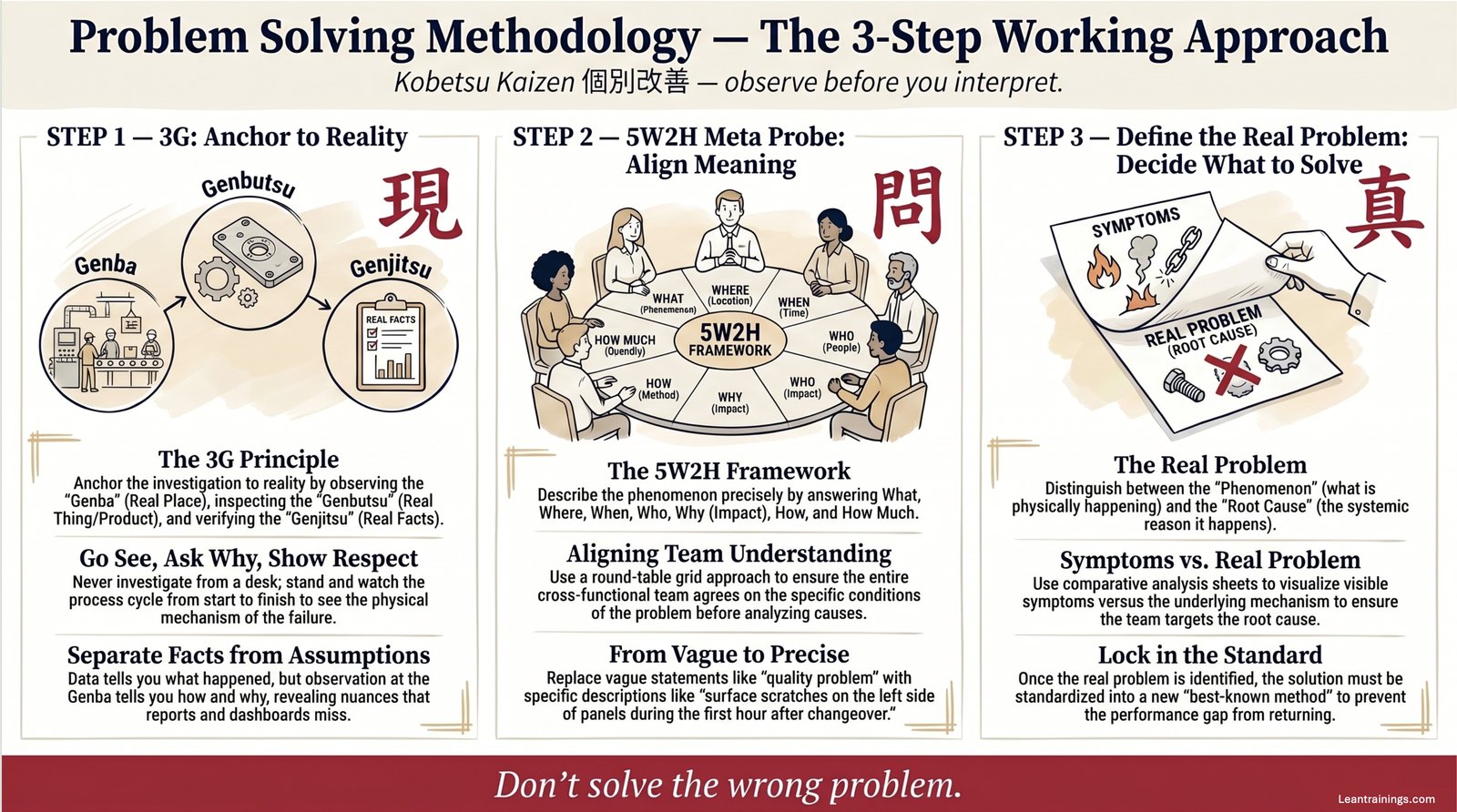
A problem solving methodology is the working order in which we observe a problem, interpret it, and define the right thing to solve. Not the comforting order. The working one. We’ve watched teams skip Step 1 and burn weeks fixing the wrong issue. We’ve watched leaders decide what the problem is in a meeting room and then ask the floor to validate the decision. The methodology exists to keep us honest.
This article is the 3-step approach we actually run when the line stops, the customer complains, the metric drops, or the audit fails. It’s anchored in Kobetsu Kaizen — the targeted-improvement Lean methodology — and uses two specific tools in a specific order: the 3G principle and the 5W2H Meta Probe. It mirrors the framework Mario Mason wrote about in his blog Are You Working on the Wrong Problem? — which is the canonical reference for this approach.
If we want the broader Lean foundation that underpins all of it, the 5S methodology pillar guide is the natural starting point.
What “problem solving methodology” actually means
When teams ask what is problem solving methodology, they usually expect a list — five steps, seven techniques, four tools. That’s the wrong frame. A problem solving methodology is not a checklist of techniques. It’s an order of operations designed to stop us from solving the wrong problem.
Most lists we see online — the 5 methods, the 7 techniques, the 4 key tools — describe techniques (5 Whys, fishbone, Pareto, A3, PDCA, DMAIC, 8D). Techniques are the verbs. A methodology is the sentence those verbs sit inside.
Kobetsu Kaizen — individual targeted improvement in Japanese — is the Lean methodology built for this. Three phases, in this order:
- Anchor to reality (3G). Observe before interpreting.
- Align meaning (5W2H Meta Probe). Surface how each person on the team builds the “movie” of the situation.
- Define the real problem. Compare the objective facts with the subjective interpretations, then write down what the team is actually trying to solve.
Only after step 3 do we get to root-cause analysis, corrective actions, and standardisation. The mistake we see most often: teams jump from a symptom straight to “5 Whys” — and they get a clean root-cause document for the wrong problem.
Step 1 — Anchor to reality (the 3G principle)
The first step in any problem solving methodology is not “define the problem.” It’s observe the problem in its physical reality, before interpretation. That’s the 3G principle:
- Genba (現場 — real place). Go to the place where the gap shows up. Production line? Office? Meeting room? If the problem only exists in spreadsheets, that’s already a clue.
- Genbutsu (現物 — real thing). Observe the object involved. If a report is late, look at the report. If a machine is down, touch the machine. If there’s a defect, hold the defective part.
- Genjitsu (現実 — real facts). Remove the drama. What are the raw, measurable, verifiable data?
3G builds the reality-based dossier. Photos. Data. Physical samples. Time-stamped logs. Anything that survives in a courtroom.
This step alone disqualifies most “problems” we hear stated in meetings. “Throughput is down” without 3G is a slogan. “Throughput on Line 4 dropped from 1,200 to 940 units/shift over the last 11 shifts, with the drop concentrated in shifts 7–11” — that’s a problem statement we can work with.
For a deeper read on this trap, see Mario Mason’s blog Are You Working on the Wrong Problem? — that’s the post this article is built on.
Step 2 — The 5W2H Meta Probe
Once the objective facts are in place, we run a 5W2H Meta Probe with the team. It’s not the surface-level 5W2H most people learn — what / why / who / where / when / how / how much used as a checklist. We use it as a Meta Probe: a tool to surface how each person on the team has internally built the meaning of the problem.
We send the 5W2H form to participants before the meeting and ask them to complete each point individually. Then we compare the answers in the room. The disagreements are the data.
The 5W — qualitative structure
- What: What is the specific gap between the Genjitsu facts and the desired state?
- Why: Why is this condition labelled as a problem? What meaning are we assigning to it?
- Who: Who perceives this as a problem? The customer? Management? The shift team? The auditor?
- Where: Where does it truly manifest — only at the Genba, or also in the mental dimension (future fear, reputation, pressure)?
- When: When does the problem state activate? Only when reviewing data? Only during reviews?
The 2H — process and impact
- How: How does the team internally build the “movie” of this situation? What’s the implicit narrative?
- How much: What’s the real impact in time, energy, money? How much waste do we generate if we only solve symptoms?
This step removes the noise of the internal world the way 3G removed the noise of the external world. By the end of the Meta Probe, the team has a shared understanding of what they actually mean when they say problem.
Step 3 — Define the real problem to solve
Now we synthesise. Compare the objective dossier (Step 1) with the perception map (Step 2). Write down the consolidated problem statement.
The marker we use: a problem statement is real when (a) every point can be verified by physical evidence, and (b) every team member agrees that’s the problem they’re trying to solve. If either is missing, we’re not ready for root-cause analysis. We’re ready for another round of Step 2.
This is also the step where most external problem-solving models part ways with Kobetsu Kaizen. PDCA, DMAIC, A3, 8D — all assume the Define step is a 30-minute paragraph at the top of a template. In Kobetsu Kaizen, Define is the longest step. Sometimes a full day. Because the cost of skipping it shows up in week three, four, five — when the team realises the corrective action isn’t moving the metric.
A useful rule we’ve watched plants live by: “if Step 3 felt fast, you skipped it.” That rule alone separates a working problem solving methodology from a process documented for an audit.
Common methodologies, and where Kobetsu Kaizen sits
A quick map of the well-known problem-solving models, and how they relate to the 3-step approach above:
| Model | Origin | What it covers | Where Kobetsu Kaizen sits |
|---|---|---|---|
| 5 Whys | Toyota | Root-cause questioning | A technique used inside Step 3+ |
| Fishbone (Ishikawa) | Quality engineering | Cause categorisation | A technique used inside Step 3 |
| PDCA (Plan-Do-Check-Act) | Deming | Improvement cycle | A cycle — Kobetsu Kaizen lives inside the Plan phase |
| DMAIC | Six Sigma | Define-Measure-Analyze-Improve-Control | A cycle — heavier, more statistical |
| A3 | Toyota | One-page reporting format | A format, not a methodology |
| 8D (Eight Disciplines) | Ford / automotive | Customer-complaint protocol | A protocol — see our 8D-specific post |
| Kobetsu Kaizen | Lean / TPM | Targeted-improvement methodology | The integrative method that uses the techniques above in order |
The point is not that Kobetsu Kaizen replaces these. It uses them. 5 Whys is a technique we apply during root-cause work. Fishbone is a technique we apply during cause categorisation. A3 is a format we report results in. Kobetsu Kaizen is the methodology that decides when each technique runs.
For the customer-complaint flavour specifically — the protocol we use when the customer is the one defining the problem — see our 8D problem solving training post (activate once Post 5 is published).
How to learn Kobetsu Kaizen problem solving without the consultant fog
We don’t need a $5,000 corporate program to use this problem solving methodology. We need the working version: the 3G, the 5W2H Meta Probe, and the discipline to define the real problem before solving anything.
Lean Trainings has a free Ronin Problem Solving course that walks through Kobetsu Kaizen in three short modules — built by Lean coaches with 20+ years inside real production environments. After the course, the $5 Ronin Problem Solving certification on the certifications page gives a verifiable credential. For the practical-execution layer — applying Kobetsu Kaizen in real operations — the Ninja Problem Solving course picks up where Ronin stops.
In short
- A problem solving methodology is an order of operations, not a list of techniques.
- The 3-step working approach: 3G (anchor to reality) → 5W2H Meta Probe (align meaning) → Define the real problem.
- Kobetsu Kaizen is the integrative Lean methodology that uses the well-known techniques (5 Whys, Fishbone, A3, 8D) in this order.
- The most common failure mode: skipping straight from a symptom to root-cause analysis, and solving the wrong problem.
- Start with the free Ronin Problem Solving course; the $5 cert is the resume-ready verifiable credential.
FAQ
Q1: What are the main problem-solving methodologies? A1: The most widely used are PDCA (Plan-Do-Check-Act), DMAIC (Six Sigma), A3 (Toyota one-page format), 8D (automotive customer-complaint protocol), and Kobetsu Kaizen (Lean targeted improvement). Kobetsu Kaizen is the methodology built specifically to integrate the others — using techniques like 5 Whys and Fishbone inside a disciplined 3-step order: 3G observation, 5W2H Meta Probe, and real-problem definition.
Q2: What is the first step in problem solving? A2: The first step is not defining the problem. It’s the 3G — Genba (real place), Genbutsu (real thing), Genjitsu (real facts). Observe the problem physically before interpreting it. Most teams skip 3G, jump to 5 Whys, and produce a clean root-cause document for the wrong problem.
Q3: What are the 7 problem-solving techniques? A3: The most-cited list is: 5 Whys, Fishbone (Ishikawa) diagram, Pareto analysis, brainstorming, mind mapping, SWOT, and PDCA. These are techniques — verbs we apply to a problem. Kobetsu Kaizen is the methodology that decides which technique runs at which step.
Q4: What are the 5 C’s of problem-solving? A4: The 5 C’s framework — Clarify, Collect, Cause, Counter, Confirm — is a managerial shortcut for the structured-problem-solving sequence. It’s a useful summary, but it skips the cultural step that makes the working version stick: aligning the team’s interpretation of the problem before defining it. That’s what the 5W2H Meta Probe step adds.
Q5: What is Kobetsu Kaizen? A5: Kobetsu Kaizen — individual targeted improvement in Japanese — is the Lean methodology for solving specific, scoped problems on the shop floor. It runs in three phases: anchor to reality (3G), align meaning (5W2H Meta Probe), define the real problem. It is the integrative method that uses well-known techniques (5 Whys, Fishbone, PDCA) in a specific order designed to prevent solving the wrong problem.
The next time someone says “we have a problem,” we either jump straight to solutions and hope — or we run the 3-step approach: 3G, 5W2H Meta Probe, then define what we’re really trying to solve. The free Ronin Problem Solving course on Lean Trainings walks through Kobetsu Kaizen in three short modules. The $5 certification on the certifications page is the verifiable credential that turns the method into a line on the CV. Start the free Ronin Problem Solving course →

