
Reading time: ~12 min
You know the moment. Someone says “5S” in a meeting like everybody at the table already knows exactly what it means. People nod. Someone mentions Sort and Sustain. Someone else says the area “needs better standards.” And we sit there doing professional theatre — listening, following enough to stay alive, hoping nobody turns and asks us a specific question.
Here’s the working version of 5S methodology: what it is, what it isn’t, and how to talk about it without sounding like we read three LinkedIn posts five minutes before the meeting. No consultant fog. No academic tourism. Just the plain mechanics, the five steps in order, and the bit most people get wrong.
If we have ten minutes, we leave with enough 5S to stop bluffing and start answering.
What is 5S methodology?
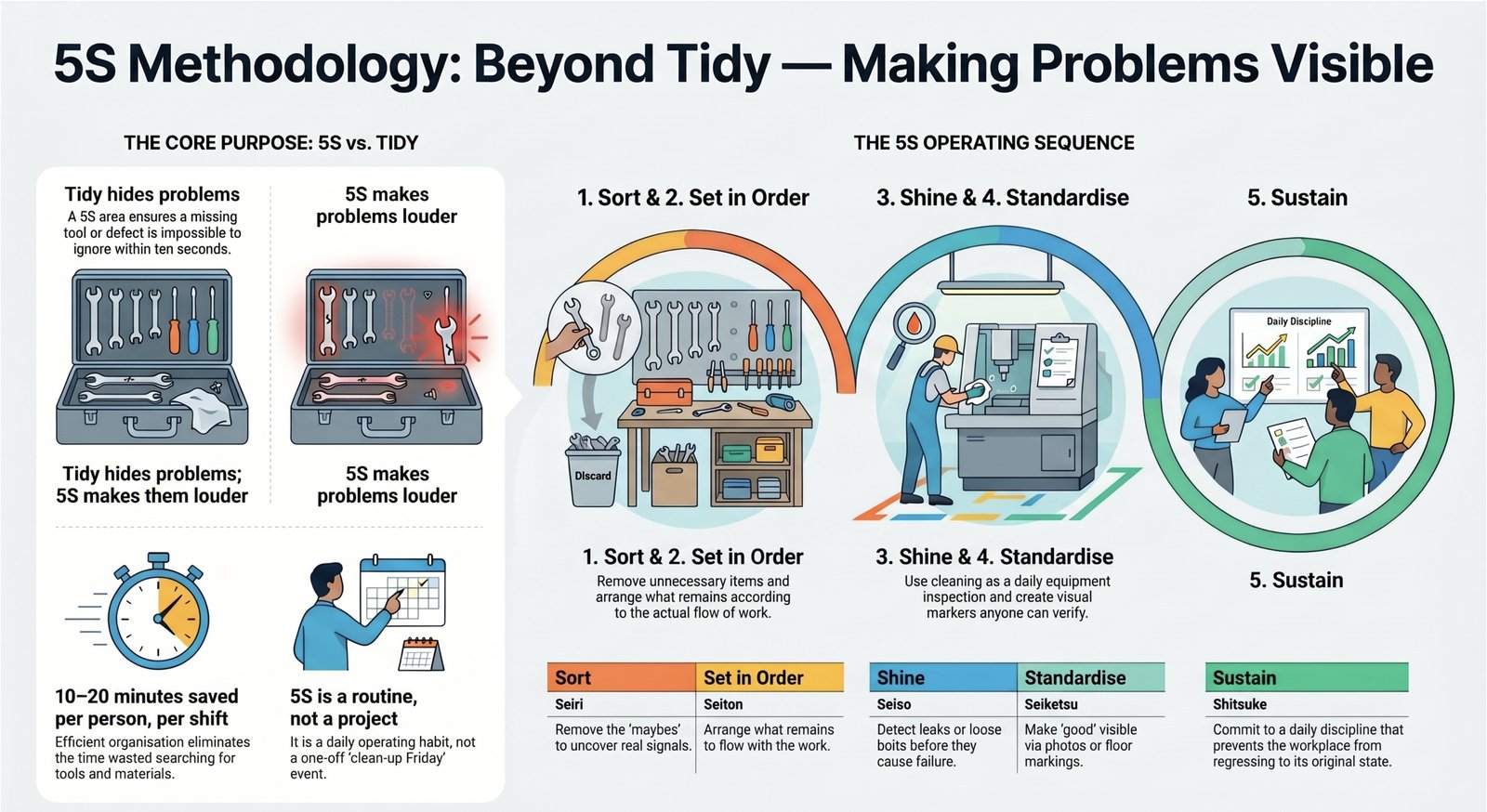
5S methodology is a five-step workplace organization system that arranges tools, materials, and information around the actual flow of work — and makes anything out of place obvious at a glance. The five steps run in order: Sort, Set in Order, Shine, Standardize, Sustain. Each builds on the one before. The point is not to make a place look pretty. The point is to make abnormal conditions impossible to hide.
Most of us first met the 5S methodology as a tidying campaign. That’s the shortcut version, and it’s wrong. A clean area is an output of 5S, not the purpose. The purpose is to create the conditions that let work flow — so a missing tool, a misplaced part, or a poor-condition machine shows up before it turns into a stoppage, a defect, or a safety incident.
That single shift — from “make it tidy” to “make problems visible” — is what separates a real 5S workplace from a workplace that just had a clean-up Friday.
What does 5S stand for?
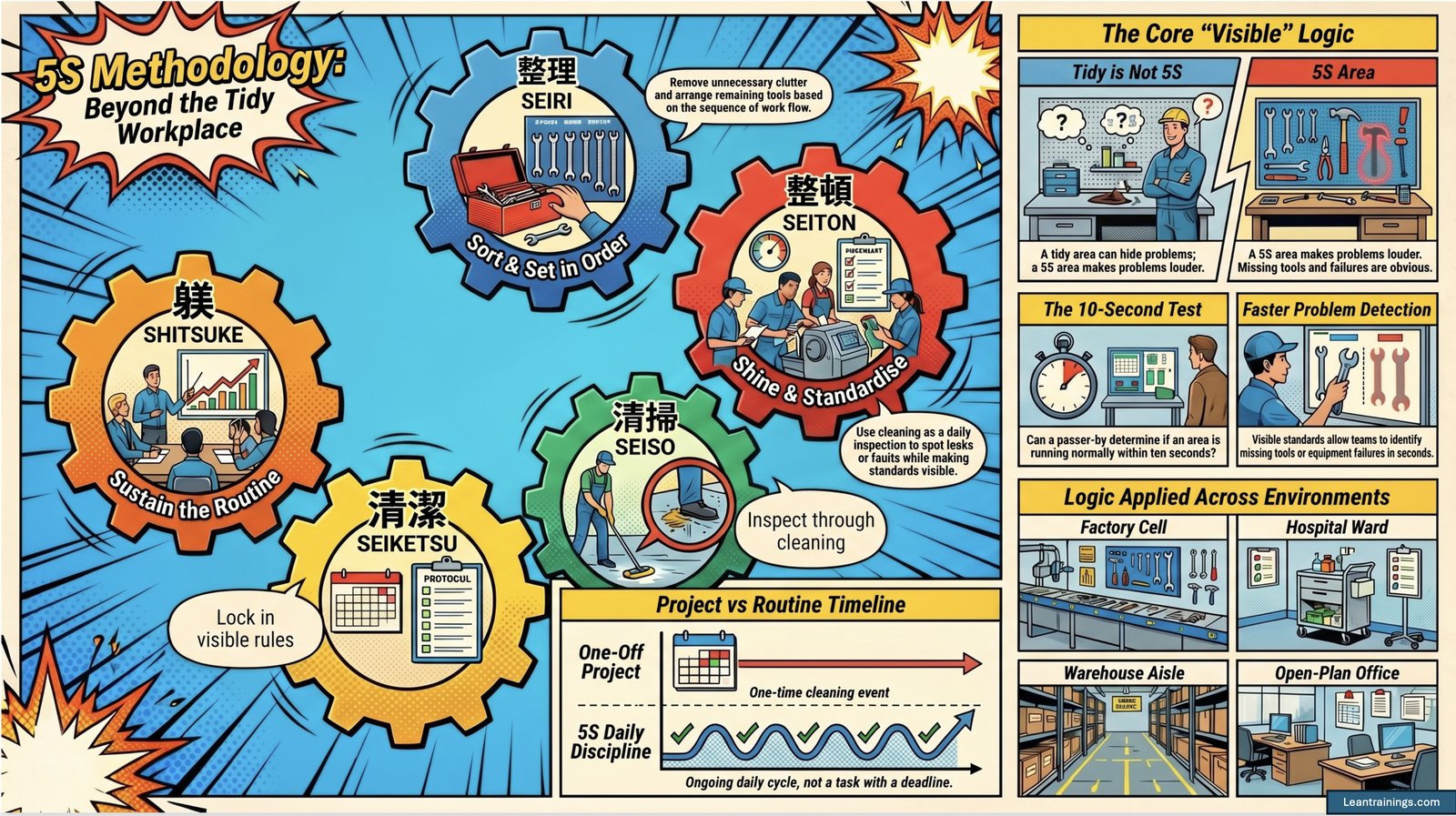
The five Ss come from five Japanese words. Each one was translated to an English word that also starts with S, so the name still works:
| # | Japanese | English | What it actually does |
|---|---|---|---|
| 1 | Seiri | Sort | Decide what belongs and remove what doesn’t |
| 2 | Seiton | Set in Order | Put what stays where the work sequence asks for it |
| 3 | Seiso | Shine | Clean as a daily form of inspection, not a chore |
| 4 | Seiketsu | Standardize | Lock the routine into a visible standard anyone can follow |
| 5 | Shitsuke | Sustain | Keep doing it shift after shift after shift |
So when someone asks what does 5S stand for, the short answer is Sort, Set in Order, Shine, Standardize, Sustain. The longer answer — and the one that actually matters — is Seiri, Seiton, Seiso, Seiketsu, Shitsuke: a Japanese-rooted method built inside Toyota and refined across decades of real production work.
The five S steps, in order, and why the order matters
We see teams mix up the steps all the time. They standardize before they sort. They shine before they set in order. The whole thing collapses, and they blame the method.
Here’s what each of the five S steps actually does, in the order they’re meant to run.
1. Sort (Seiri)
Walk the area with a critical eye. Anything we don’t need for the work that happens here, in the time horizon we care about, gets removed. Old fixtures. Broken tools nobody throws away. Three of something we only ever use one of. Boxes “we’ll deal with later.”
Sorting is unpopular because it forces decisions. That’s the point. A workplace cluttered with maybes is a workplace where real signals get buried.
2. Set in Order (Seiton)
Now arrange what’s left around the flow of work, not around what looks neat. The tool a person reaches for first sits closest. The tool they reach for tenth sits further. Information needed to start a job is at the start of the line, not in a binder somebody has to walk for.
Done well, Set in Order looks almost boring. Done badly, it looks like a tidy supply closet that has nothing to do with how the work actually runs.
3. Shine (Seiso)
Cleaning is the cheapest inspection routine ever invented. When an operator wipes down a machine every shift, they touch it. They see the leak before it puddles. They notice the loose bolt before it shears. They feel the unusual heat before the bearing fails.
Shine is not janitorial. It’s a daily condition check disguised as cleaning.
4. Standardize (Seiketsu)
Now write down what “good” looks like — in a form anyone walking past can see and verify. A photo on the wall. A taped outline on the bench. A whiteboard with the daily check. The standard has to be visible; otherwise it’s a procedure document in a folder, which is to say, invisible.
This is where most 5S programs quietly die. Great standards get built and then buried in a SharePoint nobody opens.
5. Sustain (Shitsuke)
Keep going. Daily. With audits, with leadership presence, with the discipline to fix the standard when reality says it’s wrong rather than pretending the area is fine.
Sustain isn’t a step we finish. It’s the step that decides whether the other four meant anything.
Why “tidy” is not 5S
This is the bit most people miss, and the reason a lot of 5S projects look great in week three and fall apart by week ten.
A spotless area can still fail 5S completely. If a missing tool doesn’t show up immediately, if a misplaced part can sit out for an hour without anyone noticing, if the standard is “looks clean” rather than “anything out of place is obvious,” we don’t have 5S — we have a clean-up campaign.
The test is not “is this area tidy.” The test is: if we walked past this area for ten seconds, would we know whether it’s running normally? That’s the visible standard logic, and it’s the engine 5S runs on.
A 5S area makes problems louder. A tidy area makes problems quieter. Those are opposite goals.
What does 5S look like across industries?
5S started on factory floors, but the same five steps apply anywhere work happens. The surface changes; the logic doesn’t.
- Factory cell. Tools shadowed on a board, parts staged in the order they’re consumed, daily condition check written on a whiteboard at eye level.
- Hospital ward. Crash-cart contents arranged so a nurse can verify completeness in seconds; gowns and gloves at the doorway in known quantities; cleaning rounds tied to handover.
- Warehouse aisle. Floor markings showing where pallets belong; a missing pallet equals a visible empty rectangle; picker tablets standardized at each station.
- Open-plan office. Shared workstations reset to a known state at end of day; printer area has a standard for paper, ink, jam-clearing tools; tickets follow a visible flow on a board, not buried in chats.
- Service desk. Daily start-up check on the queue and the tooling; recurring issues posted visibly, not just logged in the system.
Same five steps. Same logic. The work decides what “in order” means; 5S just makes that order obvious.
What are the benefits of 5S methodology?
When 5S is run as a working method instead of a tidying campaign, the benefits of 5S methodology show up in numbers, not adjectives. The honest list, in roughly the order people notice them:
- Faster problem detection. Missing tools, misplaced parts, and poor-condition equipment show up in seconds rather than after a stoppage.
- Less time wasted searching. A team that knows where everything sits saves an easy 10–20 minutes per person per shift — money that adds up fast.
- Fewer minor accidents. Trip hazards, blocked exits, hidden sharp edges all surface under Sort and Set in Order.
- Better changeover times. A standardized cell with a visible tool layout cuts the “where’s the…” loop out of every changeover.
- More reliable equipment. Daily Shine catches early-stage failures (leaks, vibration, heat) before they cascade.
- Cleaner data. When the workplace is standardized, deviations are real signals — not noise from messy reality.
- Easier onboarding. A new starter can read a 5S area and learn the work faster than from any document.
- A foundation for everything else. TPM, SMED, value stream work — they all assume the workplace tells the truth about its own condition. 5S is what makes the workplace tell the truth.
The catch: every benefit on this list depends on the Sustain step actually happening. Without daily discipline, 5S is a poster.
The most common mistake people make with 5S
The mistake is treating 5S as a project with a deadline.
A project ends. 5S doesn’t. It’s a daily operating routine — the kind of thing that sits in a 10-minute morning rhythm forever. When teams treat 5S as a “let’s do it Friday afternoon” event, they get a great photo for week three and a regression to baseline by week ten.
The teams we’ve watched make 5S stick make it part of the daily handover. Audit cycles. Visible boards. Leaders walking the area, not just emailing about it. It’s not glamorous. It’s the difference between a workplace that solves problems and one that hides them.
A second mistake we see almost as often: skipping the Sort step because it’s the uncomfortable one. People want to jump straight to the satisfying part — neat shadow boards, taped outlines, color-coded labels. But Set in Order on top of an unsorted mess is just decoration. The cluttered “maybes” stay; the visible standard becomes a lie. We have to remove what doesn’t belong before we organize what does. That’s the order, and the order is non-negotiable.
A third mistake: treating standards as documents instead of as visible objects. A standard hidden in a folder is not a standard — it’s an artifact. The standard has to live where the work happens, in a form anyone walking past can read in seconds. A photo on the wall. A taped silhouette on the bench. A whiteboard with the day’s check marks. If the team has to look something up to know what good looks like, the standard has already failed.
The pattern across all three mistakes is the same: 5S only works when the workplace itself becomes the system of record. The moment we let it slip into documents, audits, or annual events, we’ve lost it.
How to learn 5S without the consultant fog
We don’t need a giant Lean course to be useful with 5S. We need the working version: what 5S means, why “tidy” isn’t 5S, the five steps in order, and the visible-standard logic that keeps the method honest.
Lean Trainings has a free Ronin-level 5S course that strips it back to the working logic — built by Lean coaches with 20+ years inside real production environments. Three lessons. Six topics. One quiz. No fluff.
If we want to extend the picture, the Problem Solving (Kobetsu Kaizen) course and the Lean Trainings community are the next two natural stops.
In short
- 5S is a five-step workplace system: Seiri, Seiton, Seiso, Seiketsu, Shitsuke — Sort, Set in Order, Shine, Standardize, Sustain.
- A clean area is an output. The purpose is to make problems visible.
- Tidy is not 5S. The visible-standard logic is what makes the difference.
- Sustain is the step that decides whether the other four meant anything.
- Start with the free Ronin 5S course; build from there.
FAQ
Q1: What is 5S methodology in simple terms? A1: 5S methodology is a five-step workplace system — Sort, Set in Order, Shine, Standardize, Sustain — that arranges tools and information around the flow of work and makes anything out of place obvious at a glance. The point is to make problems visible, not to make the area pretty.
Q2: What is 5S meaning in Japanese? A2: The 5S meaning comes from five Japanese words: Seiri (Sort), Seiton (Set in Order), Seiso (Shine), Seiketsu (Standardize), and Shitsuke (Sustain). The method was developed inside Toyota as part of its production system.
Q3: Is 5S the same as cleaning? A3: No. A spotless area can still fail 5S completely. 5S is about making problems visible — missing tools, misplaced parts, poor-condition equipment — and a tidy area can hide those just as easily as a messy one. Clean is an output, not the goal.
Q4: How long does it take to implement 5S? A4: A first pass through Sort, Set in Order, and Shine in a single area can be done in 1–4 weeks depending on size. Standardize takes another 1–2 weeks. Sustain never ends — it becomes part of the daily routine. Anyone promising us “done in a weekend” is selling a clean-up, not 5S.
Q5: What are the main benefits of 5S methodology? A5: Faster problem detection, less time wasted searching for tools, fewer minor accidents, better changeover times, more reliable equipment, cleaner operational data, easier onboarding, and a working foundation for any further Lean tools (TPM, SMED, VSM).
Q6: Where can I learn 5S for free? A6: The free Ronin-level 5S course on Lean Trainings covers the working version — three lessons, six topics, one quiz — built by practicing Lean coaches. No prior experience required.
The next time 5S comes up in a meeting, we either sit there hoping no one asks us anything specific — or we know enough to answer like someone who belongs in the room. The free Ronin 5S course on Lean Trainings is built for exactly that. Three short lessons. The plain working version. No consultant fog. Start the free Ronin 5S course →

