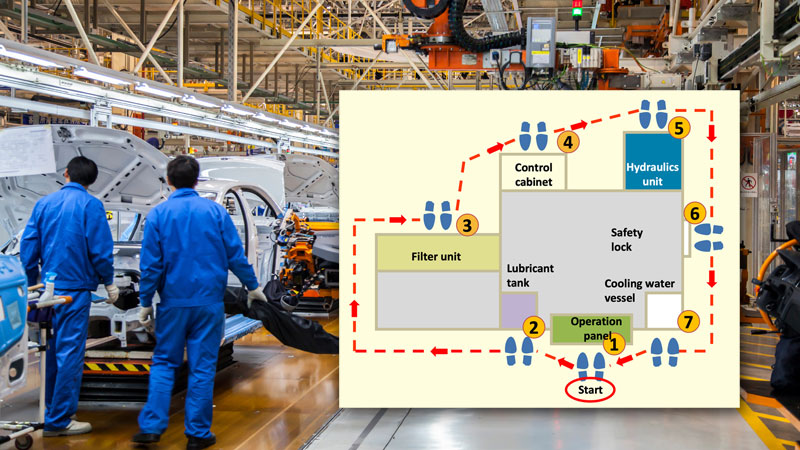

Autonomous Maintenance takes root in an organization when you are the facilitator who runs the workshops that plant it.
At the Samurai level you design the workshops that convert operator teams from reporting breakdowns to preventing them. You run the initial cleaning on the Genba, coach the team through their first tag campaign, and leave behind provisional standards the line owns on its own.
Your workshops don’t depend on your return. The team keeps the standards alive because you built the habit into the daily work cycle, not into a poster on the wall.
When a new area wants to start AM, they don’t ask for a document. They ask for you.
Course Content
Train Your Equipment Team To Find Abnormalities, Build Standards, Teach Each Other, And Pass The Next AM Step Audit
Inside Samurai, you'll use a clear Genba workshop model to move from initial cleaning to operator-led routines, relay-teaching, and audit readiness — without making AM dependent on one overworked facilitator.
Start access to all Samurai Level CoursesWhere Most AM Efforts Collapse
Most AM efforts don't collapse because people hate TPM. They collapse because the facilitator shows up with a nice slide deck, a few vague instructions, and the quiet hope that operators will suddenly start "owning" the equipment because someone said the word ownership in a meeting. That's fantasy. Expensive fantasy. On the Genba, people need structure. They need to know what to clean, what counts as abnormal, how to tag it, who owns it, how to write a useful One-Point Lesson, and what has to be true before the next AM step gets approved. And you — the facilitator — need to know what you own, what the team owns, and when to stop doing the work for them.Inside Autonomous Maintenance Samurai, you'll get:
- The Step 1 workshop structure that shows what the facilitator owns before, during, and after the Genba session — so you're not inventing the plan while operators wait for direction.
- The first tag wave method for turning oil films, loose bolts, leaks, chafing, and field fixes into visible Fuguai work the team can sort and attack.
- The contamination kaizen sheet that forces root-cause thinking at the source, instead of letting "clean it again next week" pretend to be a countermeasure.
- The One-Point Lesson format operators can use to teach normal, abnormal, and countermeasure rules on one page — because nobody is reading your 43-slide shrine to theory.
- The relay-teaching and qualification matrix system that moves AM knowledge from one cohort to the next, so capability spreads without you dragging every person across the line yourself.
Why You Need This Now
Every weak AM workshop teaches the team something. Unfortunately, it usually teaches them that Autonomous Maintenance is another management hobby. A little cleaning. A few tags. A board that gets updated until the sponsor stops asking about it. Then the machine goes back to leaking, the standards get ignored, and the facilitator gets blamed for "poor engagement." Lovely arrangement. The longer you run AM without a repeatable workshop model, the more expensive the mess gets. Operators stop trusting the program. Maintenance keeps firefighting. Leadership starts asking why the initiative looks good on paper and dead on the floor.Built by the Kaizen Coach Team
Autonomous Maintenance Samurai was built by the Kaizen Coach Team — Lean coaches who have spent more than 20 years working directly inside production environments. Not theory rooms. Not slide-deck theater. The floor. The place where bad methods get exposed fast, because machines stop, operators lose patience, maintenance gets dragged back into firefighting, and management starts asking why the AM board looks better than the actual routine. We built Samurai for the person responsible for facilitating the workshop, coaching the team, and leaving behind a routine that survives after they step back. You get the structure for Step 1 workshops, tag logic, CIL standards, One-Point Lessons, relay-teaching, qualification checks, audits, and team-trainer coaching. That's the work. Not "awareness." Not Lean wallpaper. Work. Because "go make Autonomous Maintenance work" is not a plan. It's an assignment. And assignments without structure usually become blame.Real-World Experience Behind the Training
The approach comes from work done with teams inside companies like:- Sanofi
- Rio Tinto
- Henkel
- Electrolux
- Ferrero
- De'Longhi
These are places where Lean methods either hold up under production pressure or get quietly abandoned after the sponsor stops checking.
Samurai continues that same line: facilitator-level training for taking a new zone through Autonomous Maintenance using workshops, standards, teaching cycles, qualification matrices, and audit routines.Start Training Your Equipment Team In Autonomous Maintenance — The Right Way
If you're responsible for making AM work in a real production environment, don't wing the next workshop. Samurai gives you the Genba-based structure for training an equipment team through AM: initial cleaning, Fuguai tags, CIL standards, One-Point Lessons, relay-teaching, qualification checks, and step audits. You'll know what to prepare, what to run, what to coach, and when to step back so the team starts carrying the routine without you dragging it along by the collar. Every sloppy AM workshop makes the next one harder. Operators remember when initiatives waste their time. Maintenance remembers when "ownership" turns into more firefighting. Leadership remembers when the board looks better than the floor. Click below. Start Samurai. Run the workshop like someone who knows where the hell this is going. Access is $50 per year.Start access to all Samurai Level Courses
Start immediately. Apply immediately.
About Instructor